
The Workplace Was Never Meant to Carry This Much Weight
What if the growing tension at work isn't just a leadership problem? What if it's a community problem?
Over the past several years, managers have quietly taken on a job they were never formally given. Great leaders have always known it was important to:
Coach.
Develop talent.
Drive performance.
Manage change.
Navigate conflict.
But increasingly, they're also expected to provide emotional stability for the people around them.
A recent Business Insider article, drawing on research from Harvard Business School, found that more than 80% of women in management roles spend at least 30% of their workweek on "caring tasks" — listening to colleagues' anxieties, offering encouragement, managing the emotional temperature of a room. The article calls this the empathy tax. Others call it emotional labor, or invisible work. Whatever the label, the result is the same: many leaders leave work mentally exhausted not because of strategy or execution, but because they spent the day carrying other people's emotional burdens.
Most conversations stop there. I think they're missing the bigger story.
The Real Problem May Not Be Work
Here's a hypothesis worth considering. People aren't asking more of work because they've suddenly become emotionally fragile. They're asking more of work because they're asking less of people everywhere else.
For generations, people found support through neighborhoods, churches, civic organizations, extended families, recreational leagues, volunteer groups, and lifelong friendships. Today, many of those communities have weakened.
Adults move more frequently.
Families live farther apart.
Church attendance has declined — Gallup's most recent data shows only about three in ten U.S. adults now attend religious services regularly, down from roughly four in ten two decades ago.
Neighborhoods often feel less connected.
People spend more time online “alone together” rather than physically present with each other.
The result isn't that people have evolved to need less belonging. It's that they have fewer places to find the belonging they crave. So they seek out connection where it is most convenient to find.
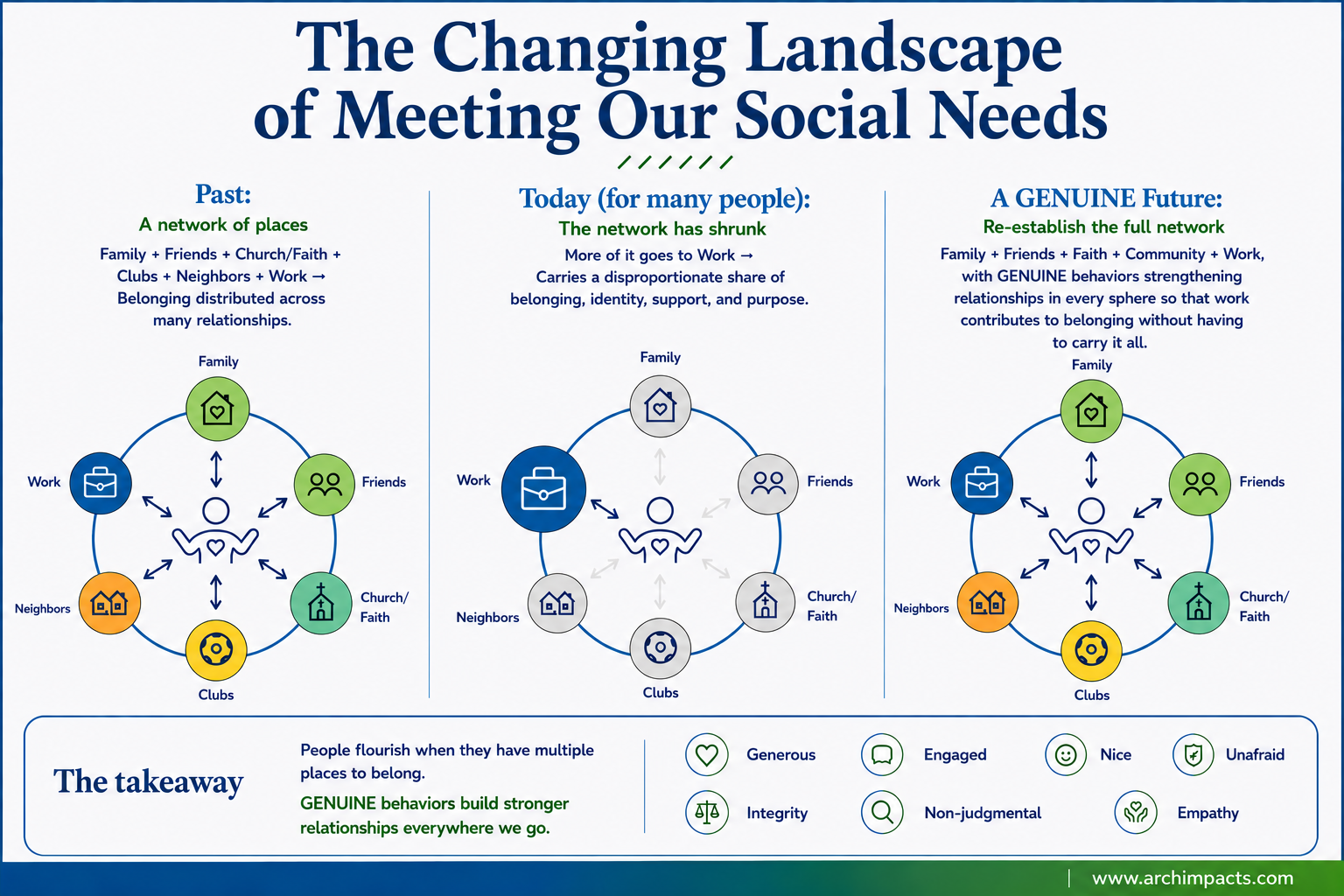
If the only people you consistently see every week are your coworkers, it makes sense that work becomes more than a paycheck. It becomes:
Your community.
Your support system.
Sometimes even your identity.
The U.S. Surgeon General's 2023 advisory on loneliness and isolation made a related point at the national level: as traditional sources of connection have eroded, disconnection itself has become a public health concern, with real consequences for both individuals and communities.
The workplace didn't ask for that role. But it inherited it.
Why Managers Feel Like Therapists
Managers occupy a unique position. They're often the most consistent authority figure people interact with outside their families. They know when someone is struggling. They notice changes in behavior.
Employees naturally begin bringing them concerns about stress, relationships, uncertainty, fear, and purpose. None of those conversations are inherently wrong in fact, many of them are healthy.
The problem comes when managers become the primary emotional outlet for dozens of people simultaneously. No one can sustainably carry that load, because empathy without boundaries becomes exhaustion, and exhaustion over time leads to burnout.
The Other Extreme Doesn't Work
If managers are exhausted, there are two tempting ways to relieve the pressure and it's worth ruling both out before looking for a real answer. The first is to swing back toward toughness. Some leaders see this growing burden and conclude we've become "too soft." The answer, they argue, is to bring back toughness. Less empathy, more hustle. More personal disciplines, less conversations.
That sounds efficient — until you look at the research.
EY's Empathy in Business Survey has repeatedly found that most employees connect empathetic leadership to concrete business outcomes: in its most recent wave, roughly nine in ten workers linked mutual empathy between leaders and employees to greater efficiency, and strong majorities also tied it to higher innovation and even revenue. Earlier waves of the same survey found similar links to job satisfaction and lower turnover.
People don't perform their best when they feel unseen. Ignoring humanity doesn't create stronger organizations. It creates quieter ones.
People stop sharing concerns.
Problems stay hidden longer.
Trust erodes.
Turnover rises.
Eventually, performance suffers. Removing empathy doesn't solve the problem it simply moves it back underground.
But Unlimited Empathy Doesn't Work Either
That's the first extreme ruled out. The second is just as tempting, and just as costly in the other direction: asking leaders to simply absorb more, to keep giving until the exhaustion resolves itself. It doesn't. The opposite extreme is equally dangerous. Managers are not therapists. Coworkers are not replacements for lifelong friendships. Organizations cannot become the sole source of meaning, belonging, and emotional support. When they try, everyone loses: employees become dependent on work for needs no organization can consistently meet, managers burn out, and leaders start avoiding difficult conversations because every conversation feels emotionally loaded. High performers quietly leave. Entire cultures end up running on empathy fumes.
Neither extreme works.
What is Breaking as We Try to Figure this out?
With both extremes ruled out, it's worth being specific about what each one actually costs. Push relationships out of the workplace entirely, and people become isolated, trust declines, collaboration weakens, and innovation slows as belonging disappears. Employees stop bringing their full selves not because they're healthier, but because they've learned it isn't safe.
Let work become the substitute for every other relationship instead, and the damage runs the other way: managers burn out, leaders become emotional first responders instead of organizational leaders, performance conversations quietly turn into counseling sessions, and healthy boundaries disappear as businesses take on problems they were never designed to solve.
In both cases, people lose. Organizations lose.
A Better Question
Instead of asking whether work should be personal or transactional, maybe we should ask:
How do we build workplaces that strengthen people without becoming responsible for everything people need?
That requires a different definition of leadership. Leaders don't have to solve every emotional problem. They do have to create environments where people experience dignity, trust, respect, encouragement, accountability, and genuine care.
That's different from therapy. It's healthy human leadership.
That is where GENUINE Fits
This is exactly where the GENUINE framework becomes practical. GENUINE isn't about turning managers into counselors. It's about helping every person become a better relational citizen. Its about building relational wealth in a time of relational poverty. When people consistently practice:
Generosity instead of keeping score
Engagement instead of indifference and distraction
Niceness through personalized kindness that communicates respect
Unafraid conversations that address issues honestly; including being vulnerable
Integrity through values aligned wholeness to builds trust
Non-judgmental curiosity before assumptions
Empathy that seeks understanding without absorbing responsibility
something remarkable happens. Belonging becomes everyone's responsibility, not just the manager's. The emotional load gets distributed across the culture instead of concentrated on one leader.
Relationships become healthier. Managers can coach instead of rescue. Employees gain support from peers instead of relying exclusively on supervisors. The organization becomes stronger because people become stronger together.
The Workplace Shouldn't Replace Community
I don't believe the goal is to make work less human. I think the goal is to help people become more human everywhere.
Imagine if organizations became places that taught people how to build healthier relationships — not only at work, but also at home, in their neighborhoods, at church, with friends, and in their communities.
The greatest contribution a company might make isn't creating employees who depend on work for belonging. It's helping develop people who know how to create belonging wherever they go.
That's a healthier employee. A healthier manager. A healthier business. And, perhaps, a healthier society.
Because the future of work isn't choosing between performance and people. It's recognizing that sustainable performance has always depended on healthy people — and healthy people rarely build healthy lives alone.
Sources
Cox, Josie. "The Empathy Tax." Business Insider (research from Harvard Business School's Deepa Purushothaman and Colleen Ammerman).
EY. 2023 EY Empathy in Business Survey and 2021 EY Empathy in Business Survey, EY US Consulting.
Gallup. "Church Attendance Has Declined in Most U.S. Religious Groups" and related Gallup Poll Social Series data on religious service attendance, 2023–2024.
Office of the Surgeon General. Our Epidemic of Loneliness and Isolation: The U.S. Surgeon General's Advisory on the Healing Effects of Social Connection and Community. U.S. Department of Health and Human Services, 2023.