
Whatever it takes
A fable about building your life around a promise and never stopping to re-evaluate the impact to yourself.
"Whatever it takes."
The extent to how much he said it out loud is beside the point, because that was the promise he made to himself.
He had failed before. More than once.
There were relationships behind him he could explain now with the benefit of hindsight. Mistakes he could name. Things he should have said sooner. Things he should never have said at all. Moments when he should have stayed for healthy conflict, and moments when he probably should have left to avoid actions and words that can't be undone.
But this time would be different.
Whatever it took to make this one last, he would do it.
At the time, it sounded noble.
Maybe it even was.
Relationships require sacrifice. Love wasn't supposed to be convenient. You didn't walk away because things became difficult. You stayed. You fought. You put someone else's needs ahead of your own. These were some of the beliefs he had built based on his previous failed attempts at forever.
He believed this time he could do it. He had learned enough that he could handle the challenges and persevere through the toughest moments.
He would be different this time. He would sacrifice himself as needed for the good of the relationship.
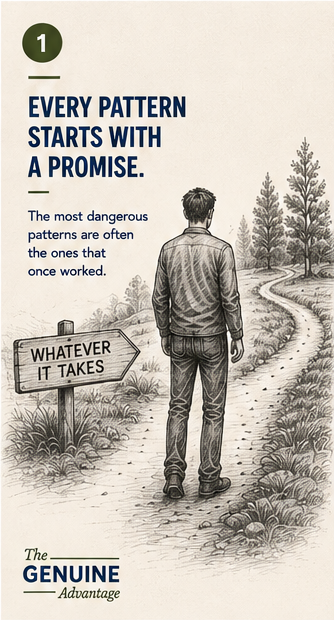
So when they disagreed, he learned to bend. At first, it was small — where they went, who they spent time with, how weekends worked, which things were worth arguing about. He discovered that some decisions simply weren't worth the friction they created. It wasn't as if it mattered to him that much. Peace has a nice feeling to it.
So he stopped making decisions.
It was easier.
And because it was easier, he did it again.
There was no meeting where they decided she would become responsible for defining whether their life was good. It just happened. If she was happy, things were good. If she wasn't, something needed to change.
Usually him.
He became remarkably good at figuring out what would make life easier for her. He anticipated problems, removed inconveniences, changed plans, absorbed frustrations. He became careful about which subjects he raised and when he raised them. Eventually he learned there were subjects better left unraised at any time.
There was always a reasonable explanation. This weekend wasn't good for seeing someone. This wasn't the right time to pursue that opportunity. That friendship created too much tension. The kids would understand. There would be another opportunity. He could always do that later.
And each individual decision seemed small enough to justify.
That is the strange thing about losing yourself in a relationship. It rarely asks for your whole identity at once.
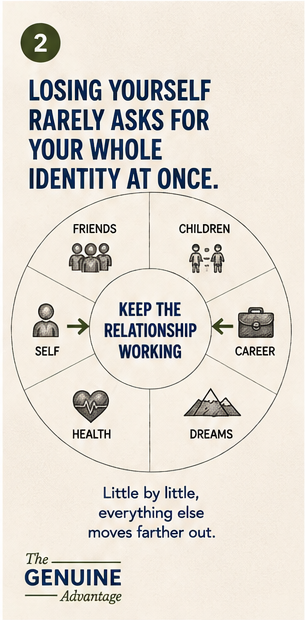
His children noticed before he did.
His daughter turned twelve that spring, and she'd asked for one thing: that he be the one to take her to the father-daughter dance, not drop her off and pick her up like the year before. He'd said yes without thinking twice. Then the week arrived, and so did a bad stretch at home — a fight still smoldering from Tuesday, the kind that would flare again if he left for the evening with plans that didn't include her. He told his daughter something had come up. He promised to make it up to her.
She said okay. She was already learning not to expect otherwise.
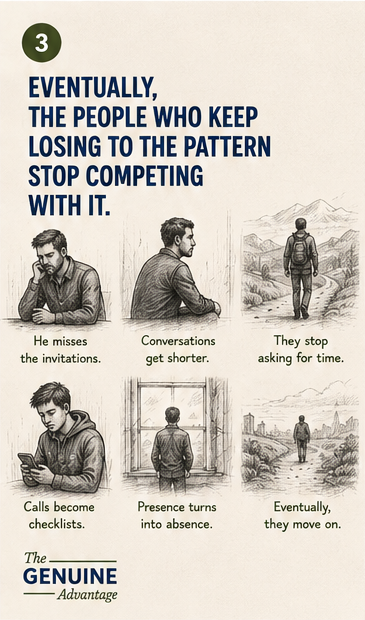
At first the kids complained. Then they argued and fought the changes. Then, as the years went by, they stopped arguing and not long after, they mostly stopped coming around.
That should have frightened him more than it did.
Instead, their absence made things easier.
He told himself they were getting older. They had their own lives. Relationships between parents and children change. He would invest in repairing things when life settled down.
But life never settled down.
He missed things. Then he stopped being invited to things. Phone calls became shorter. Conversations became more like checklists than investments in each other.
He could feel the distance, but addressing it created another problem at home, and he had already grown fond of the peace that avoiding problems at home brought with it.
Because he was achieving his goal. This relationship was lasting.
So he made the same decision he had learned to make everywhere else. He chose the thing that reduced today's friction.
Someday, he told himself. Someday he would explain. They would understand that he had been trying to achieve a promise he made to himself for the good of everyone.
His career went next.
Not dramatically. There was no resignation letter written in anger or spectacular professional collapse. There were simply opportunities he couldn't pursue, responsibilities he couldn't take on, trips that became difficult to justify, risks that no longer seemed responsible.
His world needed to become predictable because unpredictability created stress, and stress had consequences on his ability to achieve the goal.
So the man who had once imagined building something significant began organizing his ambitions around what his relationship could tolerate.
He called it being a good partner. He had learned the dangers of ambition before.
Maybe some of it was for the best. Careers weren't everything. Achievement wasn't everything. People sacrificed professionally for their families every day.
But somewhere along the way, there was an important distinction he stopped making.
He wasn't choosing his relationship over his career.
He was choosing the absence of conflict over both.
His body eventually joined the list of sacrifices worth making.
At first it just squeaked a little. He didn't sleep well. His energy disappeared. He had to watch the spicy foods and cut back on caffeine or his stomach would be a mess.
Things that had once been easy became exhausting. His body hurt. He got sick more often. Stress settled into places he couldn't reason with.
Doctors asked questions about sleep and exercise and stress. He answered them like someone describing another person's life.
He knew he needed to take better care of himself.
He would.
Soon.
But there was always something more urgent — the other person's crisis, the other person's happiness needing attending to, the other person's emotional state needing protection. Taking care of himself sometimes meant making choices that inconvenienced her joy. And he had spent years becoming very good at not doing that.
So even his health became negotiable.
The Day the System Stopped Working
Then one day the system stopped working.
It wasn't a decision. It wasn't a shift in mood. It wasn't something that could be traced back to a single argument or a single bad week.
It was medical.
A slow, quiet unraveling that began with fatigue she couldn't explain. Then pain that moved without pattern. Then days where getting out of bed required more effort than it should have. She went to doctors. She tried treatments. She followed instructions. They ran tests that came back inconclusive, then contradictory, then increasingly alarming.
At first, they thought it was stress. Then hormones. Then something autoimmune. Then something they still didn't have a name for. Each new possibility came with a different set of hopes and disappointments, like doors opening and closing in the same hallway.
She wasn't happy. Not momentarily irritated. Not having a bad week. Not frustrated about something he could fix.
Something inside her had changed in a way neither of them could negotiate with. Joy didn't just fade — it became inaccessible, as if her body had quietly withdrawn permission for it.
The life he had spent years constructing around her stability could no longer produce stability in her.
And for perhaps the first time, there was no obvious thing he could do to keep winning.
There was one appointment he still thought about afterward. A specialist, the fourth or fifth that year, running through the same intake questions in the same clipped voice. Halfway through, his wife stopped answering and just looked at the floor. The doctor asked the question again, gently, as though she hadn't heard it. She still didn't answer. So he answered for her — the sleep, the pain scale, the medications, all of it, from memory, without checking his notes. The doctor nodded and kept typing. His wife didn't look up until they were back in the car, and when she did, she said, quietly, "You know me better than I know me right now." He didn't know if that was a compliment or a warning. He still doesn't.
As it got worse, she finally needed him in ways she never had. She was now reliant on his strength, love, and attention.
That should have empowered him.
Instead, it terrified him.
Because he knew only one response to suffering.
Work harder.
So he did. He became more attentive, more accommodating, more careful. He searched for things that might help. He learned medication schedules, appointment notes, specialist names. He changed routines around flare-ups and recovery windows. He took things off her plate before she had to ask. He gave her space when she was overwhelmed and closeness when she was afraid. He tried to become whatever the illness required him to be in that moment: caregiver, advocate, buffer, witness.
But nothing worked in the way he understood "working."
There was no improvement he could reliably produce. No pattern he could master. No version of effort that guaranteed relief.
The equation he had built his life around had broken in a way effort could not repair.
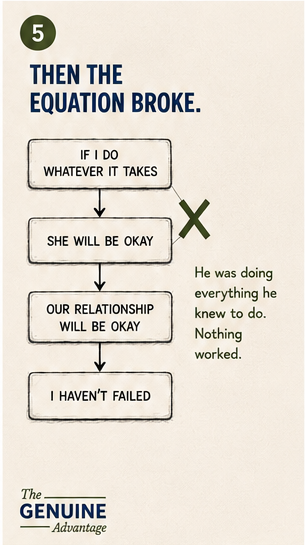
For years, he had unconsciously believed:
If I do the right things, she will be okay.
If she is okay, our marriage is okay.
If our marriage is okay, I haven't failed again.
Now he was doing everything he knew to do.
And she still wasn't okay.
Eventually, desperation forced him to consider something he hadn't seriously considered in years.
Maybe the rules needed to change.
Not the marriage.
The rules.
Maybe love wasn't the elimination of suffering. Maybe it wasn't something you could optimize into stability. Maybe he could have needs without being selfish. Maybe disagreement didn't mean the relationship was failing. Maybe she could be unwell and the relationship could still be real. Maybe his other relationships deserved more than whatever remained after the illness and the marriage consumed everything else. Maybe his health mattered. Maybe the dreams he had abandoned weren't evidence of being a good husband. Maybe there was a difference between sacrifice and disappearance.
Maybe he could achieve happiness in a new way. After all, the situation had dramatically changed.
So he tried. He started saying what he actually thought. He tried establishing boundaries. He tried reconnecting with people. He tried making decisions based on what was sustainable for both of them rather than what produced the least immediate strain. He tried building a life that could hold illness without collapsing around it.
And things got worse. Of course they did.
He had spent years teaching the relationship how he would respond to distress. Now he was responding differently.
The old arrangement may have been slowly wearing him down, but it was predictable. It had rules. It had roles. It had a rhythm that even suffering had learned to move within.
The new arrangement required negotiation in the middle of uncertainty, while both of them were already depleted.
That was much harder.
Some days he held the line. Other days he didn't.
Then came a day when he was exhausted. There had been another appointment, another setback, another night without sleep. He couldn't even remember the sequence anymore.
He could feel himself preparing to explain what he needed. He knew the words. He knew what he was supposed to say. He knew the boundary he was trying to establish.
And then he looked at how much work it was going to take.
"Fine," he said.
She looked at him, not surprised, delighted in the steps back to normal.
"It's fine. We'll do it your way."
The tension disappeared almost immediately.
And there it was.
Relief.
The dangerous, wonderful relief of returning to something familiar.
He hated it.
And yet he wanted more of it.
After that, returning to Whatever it Takes was faster.
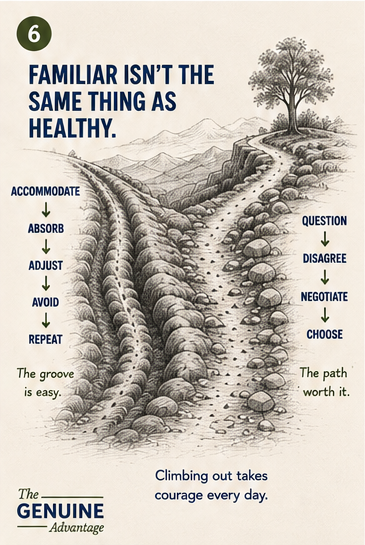
Not because he believed the old way was right. He didn't. That was almost the cruelest part. He could see the pattern while repeating it. But awareness and change aren’t the same thing.
The old way required almost no thought. He knew exactly how to do it — accommodate, absorb, adjust, avoid, keep things moving. He had practiced it for years.
The new way required courage every single day.
The old way required only habit.
So he drifted back.
Years earlier, a man had made what sounded like a beautiful promise:
Whatever it takes, I will make this relationship last.
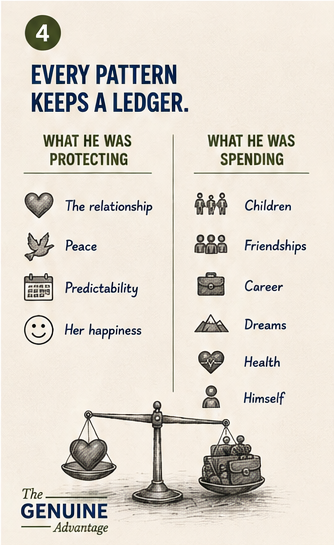
He had never stopped to ask what whatever might eventually include. His friendships. His dreams. His career. His children. His health.
Himself.
Nor had he stopped to ask a more uncomfortable question: What if making a relationship last and making a relationship good aren't the same thing?
There had been no single catastrophic decision. That would have been easier to recognize. Instead there had been thousands of reasonable decisions. Don't create an argument tonight. Don't pursue this right now. Don't upset the peace. Don't make things harder in the moment. The kids will understand. Your friends will understand. Work can survive without me. You can take care of yourself later. Just get through today.
Again.
And again.
And again.
Until a response became a behavior. A behavior became a pattern. A pattern became a life.
The tragedy wasn't that he woke up one morning and chose to give everything away. He never made that choice. That was the tragedy. He had made one choice years earlier and then stopped choosing.
Whatever it takes.
He had spent the rest of his life faithfully executing it.
And perhaps the most frightening thing wasn't how much the promise had cost him. It was how rarely he had stopped to ask whether he would still have the same goal today.
Because a life doesn't have to collapse to be lost. A marriage can survive. A career can continue. Children can grow up. Bills can get paid. Birthdays can pass. Photos can still be taken. From the outside, everything can remain remarkably intact.
Meanwhile, a person can slowly disappear inside the patterns that keep all of it functioning. Not because anyone explicitly asked him to. Not because he consciously wanted to. But because yesterday's solution became today's habit, and today's habit eventually became tomorrow's life.
He had wanted so badly not to fail at another marriage that he never stopped to ask whether success required something more than staying.
And by the time he finally asked the question, he had spent so many years becoming the person the old answer required that he no longer knew who he would have been if he'd answered differently.
Maybe that was the question he should have been asking all along.
Not:
What do I have to do to keep this?
But:
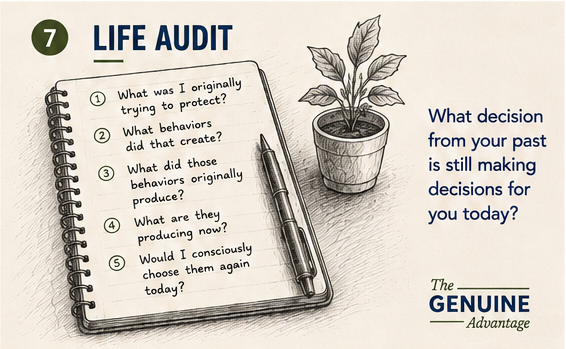
What is the way I am living producing — and if I were choosing again today, would I choose this life?
When Sacrifice Becomes Self-Abandonment
Sacrifice is consciously choosing to give something up because something else matters more. Self-abandonment begins when giving things up becomes such a default that you stop realizing you're making a choice.
The danger isn't simply developing unhelpful patterns. Some of our most destructive patterns began as effective responses to real problems. The danger is continuing to execute yesterday's solution without asking what it is producing today.
Learn more about establishing healthy relationship patterns in all aspects of your life by reading The GENUINE Advantage .