
Human in the loop was never supposed to mean human at the end of the loop
The distinction most organizations are not examining — and why it matters before the consequences arrive
Why Human Oversight Is Not the Same as Human Accountability
There is a phrase spreading through AI adoption conversations that sounds responsible on the surface.
"We still have a human in the loop."
It has become the answer that ends the question. The proof that someone is accountable. The reassurance organizations offer when asked how they are managing AI responsibly.
And technically, it is often true.
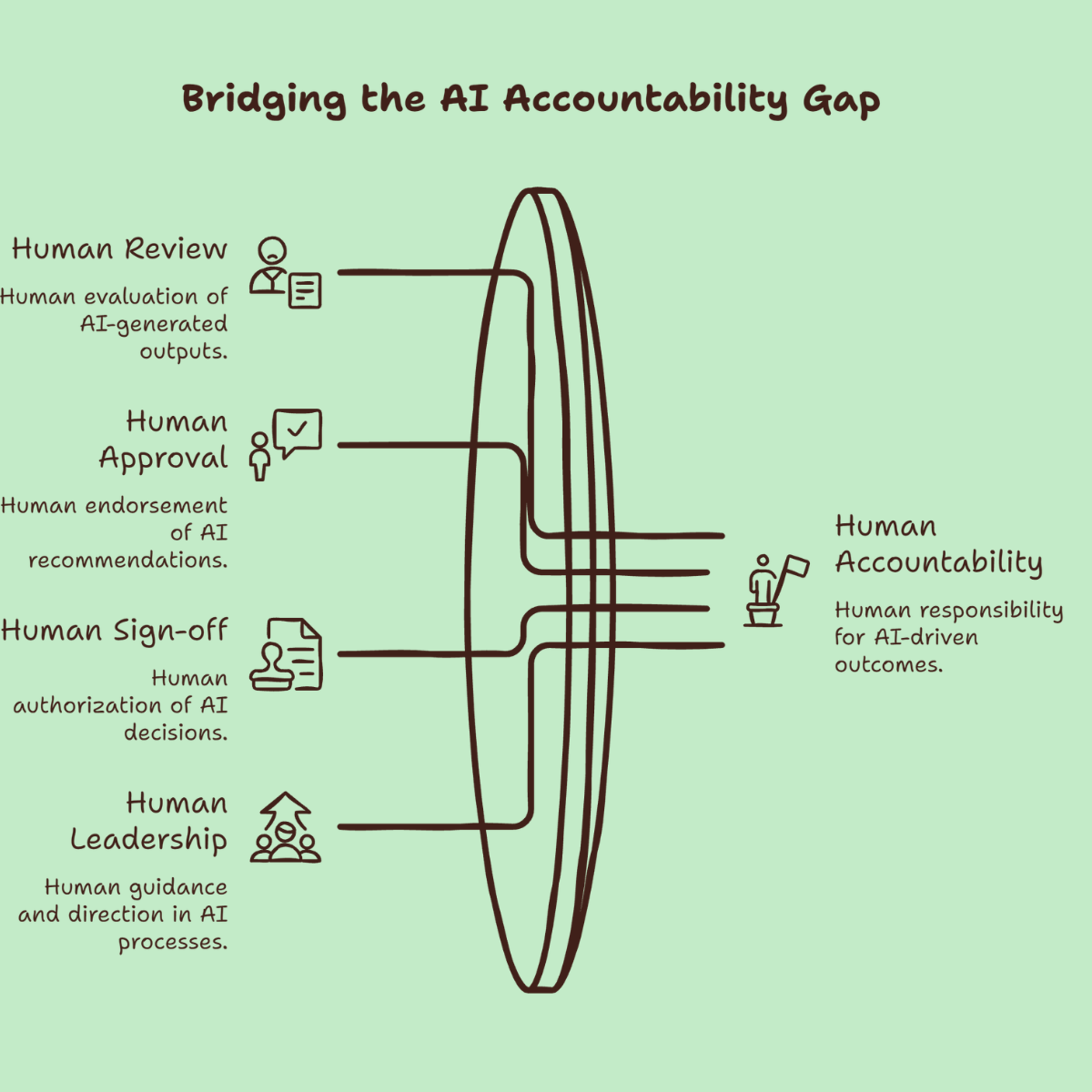
A human reviews the summary. A human approves the recommendation. A human signs off before the work moves forward.
So the loop has a human in it.
The problem is what that human is actually doing.
“Most organizations have humans in the loop. Very few have humans who lead the loop. That is a different thing entirely.
”
What the loop has quietly become
AI can now generate strategy documents, meeting summaries, performance reviews, customer responses, project plans, recommendations, and decision briefs at a speed most organizations have never experienced.
The output is fast. It is polished. It sounds complete.
And that is precisely where the danger starts — not in obvious errors, but in outputs that look right and move everyone forward before the right questions have been asked.
Instead of clarifying ownership, a meeting summary assigns tasks no one truly agreed to. Instead of having the hard conversation, someone asks AI to soften the message. Instead of challenging the recommendation, everyone assumes someone else already validated it. Instead of thinking deeply, the organization moves quickly because the output sounds reasonable. <Check out our article on creating clarity here.>
What looks like efficiency can quietly become avoidance at scale.
And the human at the end of the loop, approving the output, signing off on the recommendation, has not actually led the decision. They have cleared it to move forward.
That is not the same thing.
Approval is not accountability
The phrase "human in the loop" was originally designed to ensure that AI did not operate autonomously in consequential decisions. The human was supposed to be the backstop — the judgment that AI lacks.
But judgment requires something approval does not.
It requires asking whether the output is true, not just whether it looks good. It requires knowing what is missing from a recommendation, not just whether the recommendation sounds reasonable. It requires understanding the relational and contextual realities that will determine whether a decision actually lands — and taking ownership of what happens when it does not.
AI cannot do any of that. Not because it is not capable enough yet. Because those are not information problems. They are human problems — rooted in context, consequence, courage, and care.
An organization can have humans at every checkpoint and still have no one who truly owns the outcome. The accountability is distributed so diffusely that when something goes wrong, everyone was technically involved and no one is actually responsible.
That is not a guardrail. That is operationalized assumption.
A 2026 Grant Thornton survey found that 78% of business executives lack strong confidence they could pass an independent AI governance audit within 90 days — not because they aren't using AI, but because they cannot show who is accountable for the outcomes it is producing.
The questions the summary cannot ask
The human role in an AI-augmented organization is not to review outputs faster. It is to bring what the output cannot contain.
Is this true? Not just accurate — true to our people, our customers, our actual situation.
Is this complete? What is the recommendation not accounting for?
Is this clear? Does everyone who reads this understand it the same way?
What assumptions are hidden here? What did the model optimize for that we did not intend?
Who owns what happens next? Not who approved it — who is responsible for the outcome?
These are not questions that slow organizations down. They are questions that prevent the kind of operational breakdowns that happen when everyone moved fast and no one verified understanding.
Because AI can generate the output. It cannot own the outcome.
What "leading the loop" actually requires
The organizations that will thrive in the AI era are not the ones that moved fastest or adopted earliest. They are the ones that invested in the human capabilities that AI cannot replace — and built cultures where those capabilities are actually practiced.
That means developing leaders who bring judgment to AI outputs, not just approval. It means building teams that know how to challenge a recommendation, name hidden assumptions, and have the conversation the summary tried to soften. It means creating the kind of organizational clarity where ownership is explicit, consequences are named, and someone is genuinely accountable for what comes next.
That is not a technology problem. It is a leadership and culture problem. And no model update is going to solve it.
“Speed does not create judgment. Polish does not create clarity. And approval does not create accountability.”
The distinction worth making now
There is a window right now — before AI is so embedded in organizational workflows that the patterns become invisible — to make a deliberate choice about what the human role looks like.
One path leads to organizations where humans are efficiently present at every step and genuinely accountable for none of them.
The other leads to organizations where humans lead with the things AI cannot replicate: context, courage, relational intelligence, and real ownership of outcomes.
Human in the loop was always supposed to mean the second one.
The question is whether your organization is building toward it — or just making sure a person is technically present when the output gets approved.
Those are not the same thing.
And in the age of AI, that difference may determine whether technology creates clarity — or just scales confusion faster.
If your organization is navigating AI adoption and wants to strengthen the human capabilities that actually matter, take the AI Clarity vs. Ambiguity Diagnostic to see where the gaps are — or reach out directly to talk about what that work looks like for your team.